Collaboration Research Center 814
Additive Manufacturing
Introduction to the CRC 814
Since 2011, CRC 814 has been conducting fundamental research and development in additive manufacturing of polymers and metals. At the end of 2025, the transfer phase concluded, marking the completion of this large, interdisciplinary research project involving multiple departments and more than 35 scientists at FAU.
The CRC 814 is divided into the four projects and 1 sub-projects dealing with powder characterization, process fundamentals, component design and transfer.
- Production of complex multi-material components with defined, reproducible, and graded properties – a step toward industry-ready series production
- Holistic consideration of the process chain: Preprocessing, Processing, Postprocessing, and Quality Assurance
- Development of new material systems and process strategies
- Integration of simulation and quality assurance
The CRC has produced a number of important scientific insights, several of which have had a lasting impact on the field of powder-based additive manufacturing.
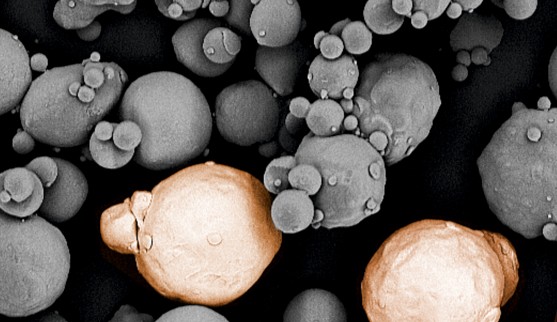
- Influence of Particle Properties: It has been demonstrated that particle size, particle shape, and electrostatic forces are key factors influencing the quality and stability of powder bed deposition.
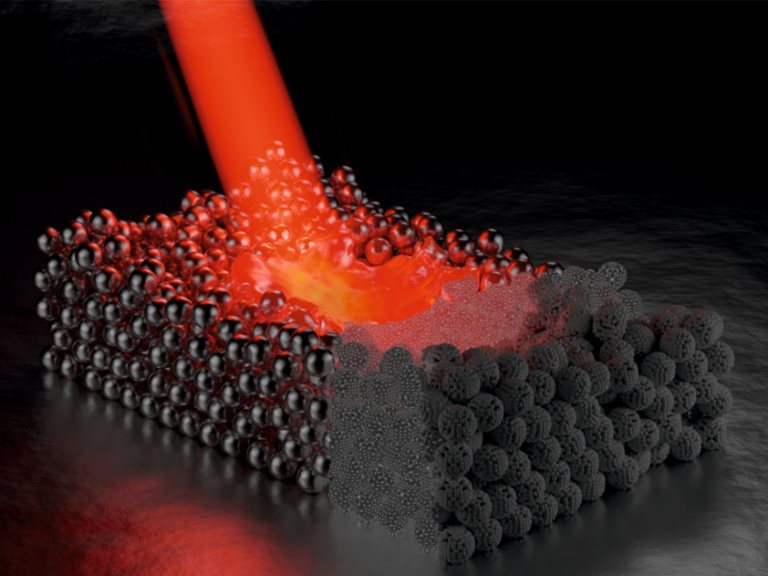
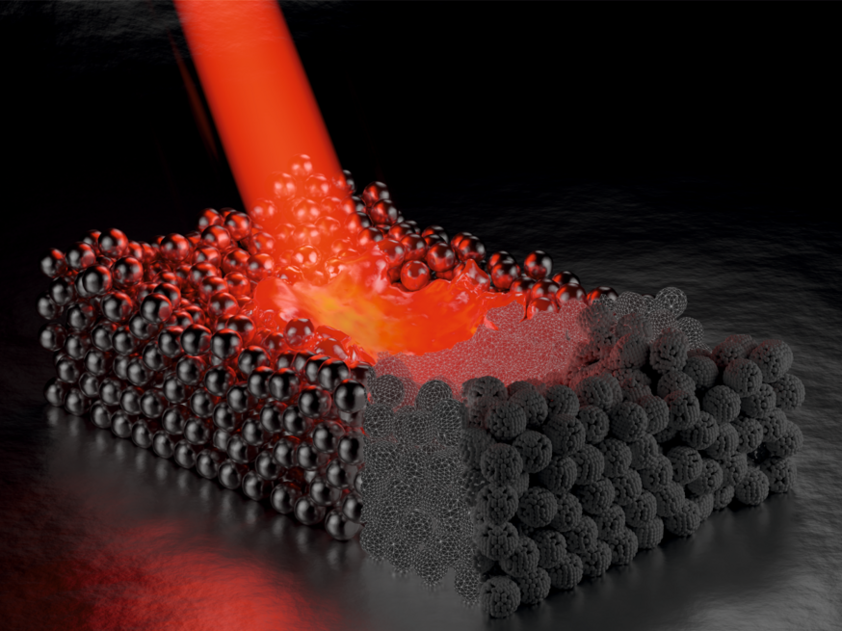
- Advanced simulation models for powder deposition: Simulation models have been further developed to now include layers that have already fused, in order to clarify the correlation between deposition rate and the integrity of the powder bed.
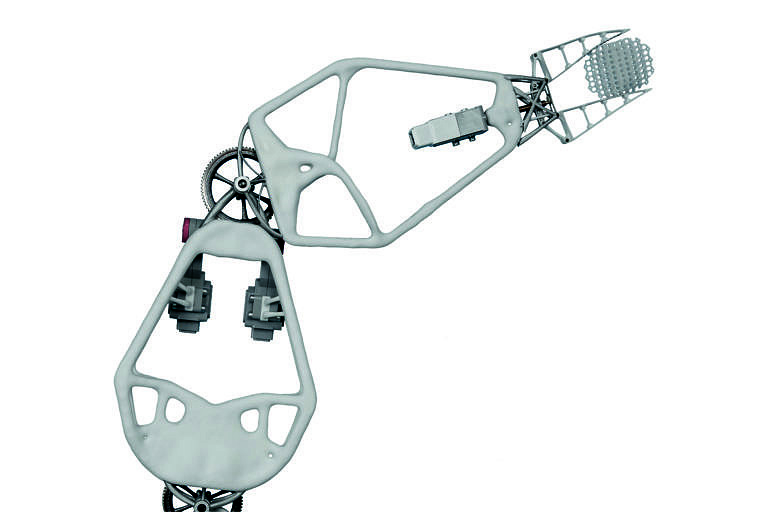
- Structural Optimization Using Lattice Structures: Models were refined to specifically integrate lattice structures into solid-body components, thereby optimizing buckling stability and reducing micro-buckling effects through graded structures.
- Prediction of Thermomechanical Properties in Metals: Significant progress has been made in predicting thermomechanical properties and reducing computation times in the simulation of laser beam melting of metals, particularly with regard to residual stresses and distortion.
- Refined Crystallization Models for Polymers: Advances in crystallization modeling now make it possible, for the first time, to conduct a detailed analysis of temperature and crystallization trends during the process.
- Microstructure-Based Property Prediction: Temperature fields derived from process simulations form the basis for microstructure modeling and enable the prediction of grain growth as well as elastic and elastoplastic component behavior using micromechanical models.
- Feedback Control for Defect Prevention: An integrated system combining monitoring and simulation makes it possible to identify deviations from the ideal process on a shift-by-shift basis and to adjust the process strategy in real time to prevent defects from forming.
- Holistic Quality Assurance: The combination of predictive simulation and in-situ process monitoring provides a new framework for the reliable, defect-free production of complex geometries with predefined, uniform properties.
Even after the official end of SFB 814, research at the individual departments will continue. The goal remains: to transfer innovations from additive manufacturing into industry and to further exploit the potential of multi-material and multi-functional components. While the CRC has officially come to an end, its scientific impact is far from over. The knowledge, methods, and technologies developed over more than a decade will continue to inspire new research, foster interdisciplinary collaboration, and accelerate the industrial adoption of powder-based additive manufacturing. With this strong foundation, the future of additive manufacturing is full of exciting opportunities.
We sincerely thank the DFG for their long-standing support.
We want to give an overview of our goals, the structure, and the people involved and hope to inspire you for the exciting, visionary production technologies shown on our website.
Contact

Prof. Dr.-Ing. Dietmar Drummer
Institute of Polymer Technology
Lehrstuhl für Kunststofftechnik (LKT, Prof. Drummer)
- Phone number: +49 9131 85-71001
- Email: dietmar.drummer@fau.de

Dr. Samuel Schlicht
Institute of Polymer Technology
Lehrstuhl für Kunststofftechnik (LKT, Prof. Drummer)
- Phone number: +49 9131 85-71073
- Email: samuel.schlicht@fau.de
Projects
News from the CRC 814